· Expert Exhaust Cleaning · Range Hoods · 5 min read
Why Soak-Tank Degreasing Beats the Dishwasher for Kitchen Filters
Soak-tank filter degreasing dissolves baked-on grease that a commercial dishwasher can’t shift, cutting fire risk and restoring proper airflow across your canopy.
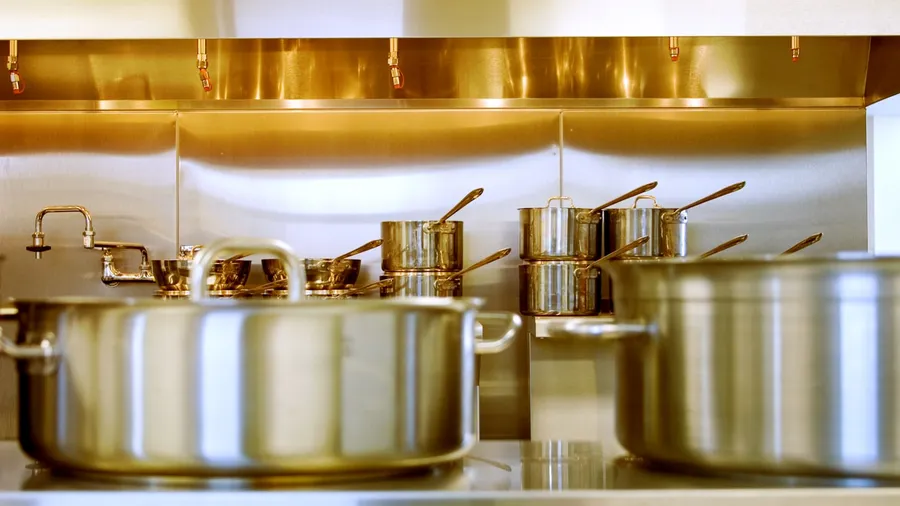
Soak-tank filter degreasing beats the dishwasher because a heated caustic soak dissolves polymerised grease from every internal baffle and mesh layer, while a dishwasher only rinses the surfaces its spray arms can reach. The result is a filter returned to bare metal, lower fire risk, and airflow restored to design spec. A dishwasher leaves hardened grease trapped inside the filter core, where it keeps feeding fire and choking your extraction.
What is soak tank filter degreasing?
Soak tank filter degreasing is the process of fully submerging kitchen canopy filters in a heated tank of alkaline degreaser so the solution penetrates and dissolves hardened grease throughout the filter. Because the whole filter is immersed, the chemistry reaches the internal baffle channels and mesh layers a spray can’t touch. Most tanks run at 50–70°C, which speeds the breakdown of polymerised grease that has been baked hard by cooking heat.
The filter comes out at bare metal, is rinsed, dried and refitted. Removing that grease matters because grease is the leading ignition fuel in commercial kitchen fires — strip it out and you remove the fire’s food source.
Why can’t a dishwasher clean kitchen filters properly?
A commercial dishwasher can’t clean kitchen filters properly because its short, high-pressure cycle only sprays exterior surfaces and can’t dwell long enough to dissolve grease bonded inside the filter. Dishwashers are built to shift food residue from plates in 60–180 seconds, not to break down grease that has polymerised over weeks of frying.
Three failure points make the dishwasher the wrong tool:
- No immersion. Spray arms miss the shadowed internal channels of a baffle filter, so grease stays put deep in the core.
- Too little dwell time. Grease breakdown needs minutes of contact, not seconds — a plate cycle is over before the grease softens.
- Wrong chemistry and heat balance. Rinse-aid detergents redeposit a grease film as the water cools, leaving filters tacky rather than clean.
The visible faces look better, so the filter passes a glance test while the fire risk inside stays exactly where it was.
Soak tank vs dishwasher — how do they compare?
Soak tank degreasing wins on grease removal, fire-risk reduction and airflow recovery; the dishwasher only wins on speed. The table below sets out the practical differences for a commercial kitchen.
| Factor | Soak tank degreasing | Commercial dishwasher |
|---|---|---|
| Grease removed | Internal + surface, back to bare metal | Surface only; internal grease remains |
| Contact time | 20–60+ minutes immersed | 1–3 minute cycle |
| Heat | Sustained 50–70°C penetrating soak | Brief hot rinse, cools fast |
| Fire-risk impact | Removes the ignition fuel throughout | Leaves fuel inside the filter core |
| Airflow restored | Near-original extraction rate | Partially blocked filter stays restrictive |
| Filter lifespan | Extended — no compacted grease load | Reduced — residue keeps building |
| Compliance evidence | Documented service record | None |
Only one of these methods returns the filter to a state that supports your extraction system and your fire safety obligations.
How does clean filter degreasing reduce fire risk?
Clean filter degreasing reduces fire risk by removing grease, the leading ignition fuel in commercial kitchen fires, from the first line of your extraction system. A grease-loaded filter sits directly above open flames and hot surfaces; one flare-up can ignite that grease and carry flame straight into the ductwork.
Filters are also the barrier that stops grease travelling into the duct and fan. When they’re saturated, grease bypasses them and coats the whole system, turning a filter problem into a full-duct fire hazard. Soak-tank cleaning keeps that barrier working, which is why it pairs naturally with scheduled range hood filter & vent cleaning.
How often should commercial kitchen filters be degreased?
Most commercial kitchens should degrease filters every 3–6 months, while high-volume sites need monthly filter cleaning with quarterly duct servicing. The right interval depends on how much grease your cooking produces, because more grease means faster loading and higher risk.
| Kitchen type | Filter degreasing | Duct cleaning |
|---|---|---|
| Cafe / light cooking | Every 6 months | Every 12 months |
| Standard restaurant | Every 3 months | Every 6 months |
| Charcoal, wok, high-volume frying | Monthly | Quarterly |
These intervals align with AS/NZS 1668.1, which governs mechanical ventilation design and the airflow your system must maintain, and support the routine servicing regime under AS 1851 for the fire protection elements of your kitchen. Cleaning to schedule keeps you inside both standards and inside your insurer’s expectations.
What does professional filter and canopy cleaning cost in Sydney?
Professional cleaning in Sydney starts from around $390 for a single-canopy clean, because pricing scales with the size of the system and the grease load it carries. Larger or heavily loaded systems need more labour and more soak-tank turnaround, which is reflected below.
| Service | Indicative cost (AUD) |
|---|---|
| Single-canopy clean | From ~$390 |
| Canopy + duct clean | $900 – $2,500 |
| Multi-storey / complex system | $3,000+ |
Every clean should come with a documented service record. That report is your evidence of compliance under AS 1851 and the proof your insurer will ask for after any incident.
Which filters respond best to soak-tank cleaning?
Baffle filters respond best to soak-tank degreasing because their solid metal channels hold up to repeated hot immersion without degrading. Mesh filters can be soaked too, but their fine layers clog faster and wear out sooner, so they need more frequent attention — a trade-off worth understanding before you choose a filter type.
If you’re weighing up filter options, our guide to baffle vs mesh filters for commercial kitchens breaks down the differences, and you can match your cleaning interval to your cooking style using how often to clean commercial rangehood filters in Sydney.
The bottom line
The dishwasher is fine for plates and useless for the grease that starts kitchen fires — soak-tank degreasing is the only method that returns a filter to bare metal and restores your extraction to design airflow. Get on a 3–6 month cycle (monthly if you fry hard) and keep the service records that prove it.
Book a soak-tank filter clean with a same-day turnaround: call 0468 070 392 or get a same-day quote and we’ll have your canopy back to bare metal and your fire risk back under control.