· Expert Exhaust Cleaning · Compliance · 5 min read
Kitchen Exhaust Compliance Checklist for New Sydney Venues
Opening a new Sydney kitchen means your exhaust has to be compliant from day one — here is the checklist that keeps inspectors, insurers and landlords satisfied.
A kitchen exhaust compliance checklist for a new Sydney venue comes down to five things: a ventilation system designed to AS/NZS 1668.1, ductwork with proper access panels, a documented cleaning schedule under AS 1851, filters matched to your cooking type, and dated certificates you can hand an inspector or insurer. Put these in place before you open, because grease build-up is the leading cause of commercial kitchen fires and each step removes or controls that fuel. Skip one and you may still trade, but you risk failing your first audit or voiding a claim the day you need it.
What should be on a kitchen exhaust compliance checklist for a new Sydney venue?
A complete kitchen exhaust compliance checklist covers design, access, cleaning, filtration and records — the five points below. Work through them in order, because each one depends on the one before it: you cannot clean a duct you cannot reach, and you cannot certify a clean you did not document.
| # | Checklist item | Standard | Why it matters |
|---|---|---|---|
| 1 | Ventilation designed and installed correctly | AS/NZS 1668.1 | Captures grease-laden vapour so it enters the duct, not your kitchen |
| 2 | Access panels along the full duct run | AS 1851 / AS/NZS 1668.1 | Lets a technician reach, clean and measure every section |
| 3 | Scheduled cleaning at the right interval | AS 1851 | Removes grease, the leading ignition fuel, before it builds |
| 4 | Filters matched to cooking type | AS/NZS 1668.1 | Traps grease at the canopy so less reaches the duct |
| 5 | Dated certificates and before/after photos | AS 1851 | Proves servicing to an inspector, insurer or landlord |
Tick all five before opening night and you turn compliance from a scramble into a booking.
Is your new venue’s exhaust designed to AS/NZS 1668.1?
Your exhaust must be designed and installed to AS/NZS 1668.1, the Australian Standard for mechanical ventilation, because a system that cannot capture cooking effluent will fail no matter how often it is cleaned. This standard sets airflow rates, capture velocity, duct construction and fire-mode fan operation at fit-out.
For a new venue this is the one standard you deal with once. Confirm your mechanical contractor sized the canopy and fan to your actual appliance line-up, since an undersized system lets grease settle on kitchen surfaces instead of drawing it away.
The two standards are easily confused, so it is worth understanding how AS/NZS 1668.1 and AS 1851 divide the work before you sign off on a fit-out.
Does your ductwork have the access panels AS 1851 relies on?
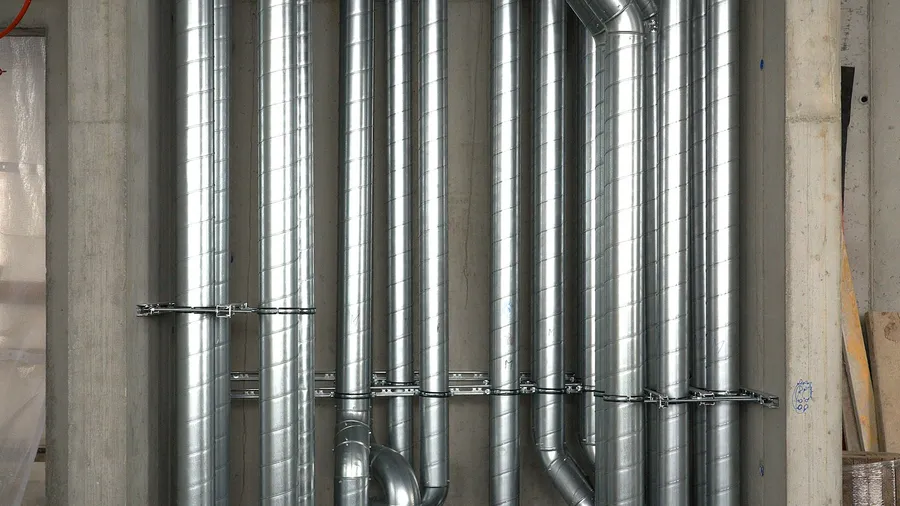
Every section of duct needs a removable, grease-tight access panel, because a length you cannot reach cannot be cleaned, measured or certified. Missing or painted-over panels are the single most common reason a new Sydney exhaust system fails its first inspection.
A practical rule is a panel at every bend plus one roughly every 3 metres of straight horizontal run, with panels top and bottom of vertical risers. Grease pools where airflow changes direction, so every unreachable elbow is a hidden fuel load exactly where a fire would travel fastest.
Check this at handover, not at your first audit — retrofitting panels after the ceiling is closed costs far more than specifying them during the build.
How often will a new Sydney venue need exhaust cleaning?
Most commercial kitchens need exhaust cleaning every 3 to 6 months, with high-output kitchens cleaned far more often, because grease deposits faster where there is more heat, oil and throughput. Set the interval by your cooking type from day one so it is never overdue.
| Kitchen type | Filters | Duct & canopy internals | Reason |
|---|---|---|---|
| Cafe / light cooking | Weekly | Every 6 months | Low grease output extends the safe interval |
| Standard restaurant | Weekly to fortnightly | Every 3–6 months | Moderate grease load needs mid-range servicing |
| Charcoal / wok / high-volume frying | Monthly | Quarterly | Dense, sticky grease coats surfaces quickly |
Charcoal grills, wok stations and high-volume frying need monthly filter cleaning and quarterly duct cleaning, because they generate the sticky grease that coats internal surfaces fastest. Booking this as a recurring service — not a one-off — is the core of ongoing compliance & safety cleaning.
What documentation does a new venue need for inspectors and insurers?
You need a dated compliance certificate, grease-depth readings and before-and-after photos for every clean, because these are the evidence an inspector, insurer or landlord actually asks to see. A verbal assurance that “it was cleaned” satisfies none of them.
Insurers in particular treat documented AS 1851 servicing as a condition of cover, since a clean you cannot prove is a clean that did not happen at claim time. Set up a service file before you open and keep every certificate in it.
Getting this wrong is expensive — see what your policy really expects in our guide to exhaust cleaning and insurance requirements.
What does compliant exhaust cleaning cost a new Sydney venue?
Compliant cleaning in Sydney starts at around $390 for a single-canopy clean and scales with duct length and complexity, because longer runs and multiple levels take more time to clean and document. Budget for it as a recurring operating cost, not a one-off fit-out line.
| Scope | Indicative cost (AUD) |
|---|---|
| Single-canopy clean | from ~$390 |
| Canopy + duct clean | $900 – $2,500 |
| Multi-storey duct system | $3,000+ |
The variation tracks how much duct there is and how heavy the grease load runs. A new venue’s first clean is usually the cheapest it will ever be, so starting your schedule early keeps every later visit faster and lower-cost.
Book your pre-opening compliance clean
Work through the five-point checklist before you open and your first inspection becomes paperwork, not panic. Call Expert Exhaust Cleaning on 0468 070 392 or get a same-day quote, and we will assess your new system, clean it to AS 1851 and hand you the certificates your inspector, insurer and landlord expect.